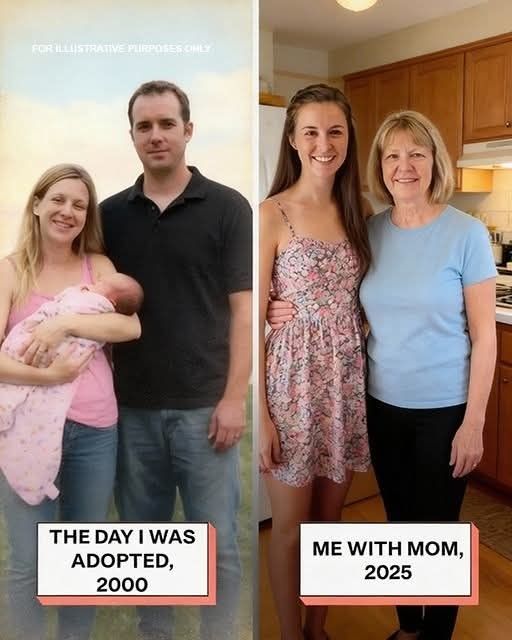
For as long as I can remember, my life has felt like it began in the middle of a sentence.
There are no soft-edged childhood memories to drift back to when I’m tired or overwhelmed, no image of flour-dusted hands pulling warm cookies from the oven, no Sunday mornings spent tangled in blankets while a mother hummed in the kitchen. My past has always felt strangely hollow, as if something essential had been edited out long before I had the chance to notice.
My name is Mara. I’m 25 years old, and I work the front desk at a modest physical therapy clinic in Tacoma, Washington. The job isn’t exciting, but it’s steady. I schedule appointments, answer phones, smile politely, and make small talk with patients who tell me more about their knees and shoulders than I ever ask to know. The predictability comforts me.
Outside of work, I disappear into mystery novels and bake late at night when the world feels quieter. Recipes are soothing, clear instructions, exact measurements, and outcomes that make sense. People, on the other hand, have always felt like puzzles missing half their pieces.
For years, I couldn’t understand why I felt so disconnected from myself, like I was living someone else’s life on borrowed time. I assumed it was just how I was wired.
I didn’t realize it was because the foundation of my identity was built on a lie.
Growing up, there was one sentence etched into my chest like a scar:
“You’re adopted. You should be grateful I took you in.”
That sentence came from Dorothy, the woman who raised me.
I never called her “Mom.” Even as a child, the word felt wrong in my mouth, like trying on shoes that didn’t fit, no matter how much I broke them in. Dorothy was meticulous, pressed skirts in neutral colors, spotless countertops, and furniture no one ever truly sat on. She spoke carefully, formally, as though every conversation was being recorded for future judgment.
Her affection, when it appeared at all, was stiff and fleeting. A pat on the shoulder instead of a hug. A nod instead of praise.
She wasn’t violent. She never screamed or struck me.
But she was distant in a way that hurt just as much.
Dorothy ran her household like an obligation she’d never asked for, and she treated me like a responsibility she regretted accepting. I learned early how to stay out of her way, how to make myself small, quiet, easy to ignore.
The house never felt like mine. I felt like a long-term guest who had overstayed her welcome.
Her husband, Arthur, was the exception.
Arthur had a warm laugh that filled the room and gentle eyes that crinkled when he smiled. He called me “kiddo” and “peanut” and never once made me feel like I didn’t belong. When I struggled with math homework, he joked that his brain worked better with numbers than words and sat beside me until I understood.
He taught me how to ride a bike on the cracked pavement outside our house, running behind me with his hands just inches from the seat until I realized I was balancing on my own. He tucked dandelions behind my ear and told me they were wishes in disguise.
When I got sick in fourth grade, he slept in the armchair beside my bed, rubbing slow circles on my back and whispering reassurances until I drifted off.
Arthur made me feel safe.
Then, when I was ten years old, he died.
One minute, he was standing in the kitchen, pouring cereal. Next, he was on the floor, unresponsive, the bowl shattered beside him. A heart attack, the doctors said. Sudden. No warning.
After his funeral, the house changed.
Whatever warmth had existed vanished entirely. Dorothy didn’t cry, not where I could see. She moved through the days like a shadow, efficient and silent, her grief hardening into something sharp and impenetrable.
She stopped touching me altogether. No goodnights. No check-ins. Barely a glance in my direction.
And she reminded me constantly that I wasn’t really hers.
When I asked if I could take ballet lessons like the other girls at school, she stared at me with a flat expression and said, “You could have been left in an orphanage. Remember that, and behave.”
She repeated that line often at home, in front of relatives, even once during a parent-teacher conference. It became my defining trait, spoken aloud as casually as someone might mention an allergy or a bad habit.
Children heard it.
And children know exactly how to turn words into weapons.
“Your real parents didn’t want you.”
“That’s why you don’t fit in.”
“Does your fake mom even love you?”
I stopped eating lunch at school and hid in the library instead. I learned not to cry where Dorothy might see—she despised tears. At home, I became invisible.
By the time I was fifteen, I had perfected the role of the Grateful Adopted Child. I said thank you for everything, even when it hurt. I apologized for existing.
Deep down, I believed I owed the world a debt I could never repay.
That was my reality.
Until someone finally asked the question I’d spent my entire life avoiding.
Lena had been my best friend since seventh grade. She had wild curls she never bothered to tame and a laugh that made strangers feel like old friends. She never pushed me to talk, never demanded explanations. She simply stayed.
One night, after another tense dinner where Dorothy accused me of being disrespectful for something as small as an eye roll I didn’t even remember making, I grabbed my jacket and left without saying a word.
Lena lived two blocks away. When she opened the door and saw my face, she didn’t ask what happened. She stepped aside and let me in.
Dorothy and I are still learning how to exist in the same space without old habits taking over. Some days are awkward. Others are quietly healing.
I’ve learned my mother’s name. I’ve seen her face in old photographs and recognized my own eyes staring back at me. We visit her grave together now.
Dorothy brings daisies, Helena’s favorite.
I talk to my mother in whispers, telling her about my job, my books, my life.
I don’t know if she hears me.
But I know this: she loved me enough to give me her life.
And Dorothy, in her own flawed, painful way, kept her promise.
She stayed.
And sometimes, staying is its own kind of love.
I’m still learning how to forgive.
But I’m finally learning who I am.
And for the first time in my life, that feels like enough.