Kid Sister creator Simone Nathan shares six Jewish touches she loves, from ceramic golems to her grandmother's embroidered challah cloths.

A show that stayed local
Simone Nathan's comedy series Kid Sister is steeped in Jewish life, which makes it odd that it went so long without a wider audience. Until recently, you could only watch it in New Zealand. Seasons one and two are now streaming on ChaiFlicks, the add-on subscription available through Amazon Prime. That's a narrow path for a show this specific. Niche comedies often stall when their distribution depends on one market and one platform, and a series built around a particular community tends to lose viewers who don't have a way to find it. Here's the thing: the specificity that made the show hard to place is also what makes it work.
Nathan grew up in a Modern Orthodox community in Auckland and studied dramatic writing at NYU. That background matters for reading the show. Modern Orthodox life sits in a middle space, where observance and secular ambition often coexist and sometimes collide, and comedy tends to mine that friction well. She worked as an assistant on Bloodline and Inside Amy Schumer, then landed a writing job on Our Flag Means Death, the 2022 cult favorite executive produced by fellow Jewish Kiwi Taika Waititi. She wrote the first season of Kid Sister entirely on her own. Solo writing on a first season is a rare kind of control, and it's usually where a show's voice either gets locked in or gets diluted by notes. Critic Evelyn Frick has compared the show to Fleabag and Shiva Baby, and the comparison holds up. Both of those touchstones trade in uncomfortable intimacy, and Kid Sister shares that bluntness. What separates it is the Jewish specificity, which is less a theme than a daily texture. Here's what brings Nathan her Jewish joy.

Ceramic golems
Handmade ritual objects sit in an odd spot in modern Jewish life. Some households treat them as decor, while others regard them as serious craft tied to a long folkloric tradition. A character who makes golems on screen puts that craft front and center, which is a risky choice if the details are wrong. Nathan is obsessed with the golems made by Annaliese Rosa. She owns two of them, plus a special mezuzah Rosa made for her wedding. The Kid Sister team asked Rosa's permission to feature the golems heavily in season two, and the show has Nathan's ceramicist character making them. That permission matters. When a production borrows a working artist's output, asking first is the minimum, and it's not always the standard. "It honestly felt a bit like stolen valour," Nathan says. Her advice: go look at Rosa's work.
Grandma's challah cloths
Embroidered challah covers are a common gift in many Jewish households, usually tied to milestones like weddings or coming-of-age events. The tradition is meant to be personal, and that's exactly what makes it vulnerable to drift. Nathan's grandmother decided every grandchild would get a hand-embroidered challah cloth for their bat mitzvah. The project has long since gotten out of hand. With so many grandkids and great-grandkids, Nathan's mum and aunts have been pitching in, and Grandma now runs what Nathan calls a solo production line of ornate cloths. Each one carries the stitched line "Every stitch a labour of love." At this point, Nathan jokes, it reads more like "Every stitch a labour of elder abuse." That's a family joke, but it points to something real. A gift that starts as an act of love can quietly turn into an obligation, and the people doing the work often aren't the ones who asked for it.
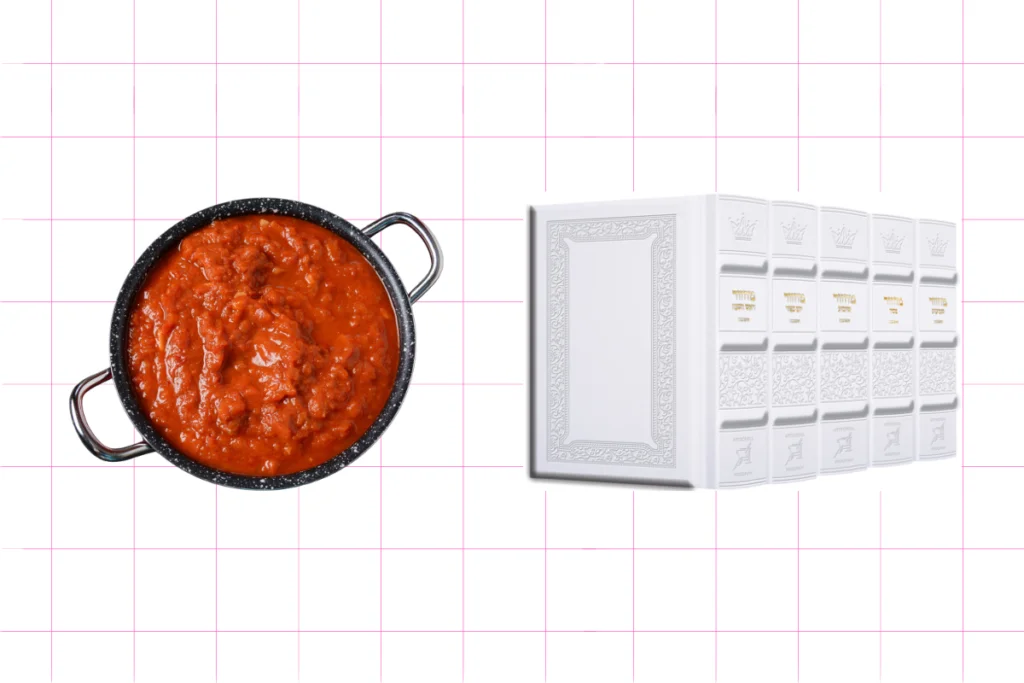
Matbucha and the Shabbat table
The family's Shabbat table is built around challah and dips: egg salad, guacamole, babaganoush, and matbucha, a Moroccan tomato and roasted pepper salad. Spreads like this are a reminder that Jewish food isn't one cuisine. It's a set of regional traditions that pass through migration, family kitchens, and whatever ingredients were nearby. By the time dinner is served, everyone is so full they barely have room for the mains. That's the real problem with a good starter spread. It tends to eat the meal. Every week they swear they'll do a dinner of only challah and dips, then forget and do it again.
Matbucha has an unusual sweet smokiness and is easier to make than it looks. Cooked-down vegetable salads like this usually reward patience more than skill, so the main trick is not rushing the process. Nathan follows Tori Avey's recipe. Her warning: don't be intimidated, it's worth it, though it will stain your Tupperware red. If you're cooking for a crowd, that staining is a small price for a dish that disappears fast.
A machzor set and a calendar hack
For her bat mitzvah, Nathan bought the five-volume ArtScroll Machzor in white with gold-embossed binding. A machzor is the prayer book used for the High Holidays, so a full set is as much about having the right books at the table as it is about reading them. She calls it classy as hell and loves pulling it out for the holidays. Her confession: one volume has never been opened, and she leaves the holiday for you to guess. (And this is the part most people overlook: owning the books is a kind of ritual in itself, even when the reading lags.)
On the practical side, Nathan uses an add-on called HebCal to load the Jewish holidays into her iPhone calendar. Holiday dates shift against the standard Gregorian calendar every year, so a fixed reminder won't do the job. It stops the chaggim from sneaking up on her, as they love to do. Baruch Hashem. If you're planning around observance without a calendar that understands it, you'll know the feeling of realizing a holiday started yesterday. Unglamorous. Useful, though.
Keeping the Faith
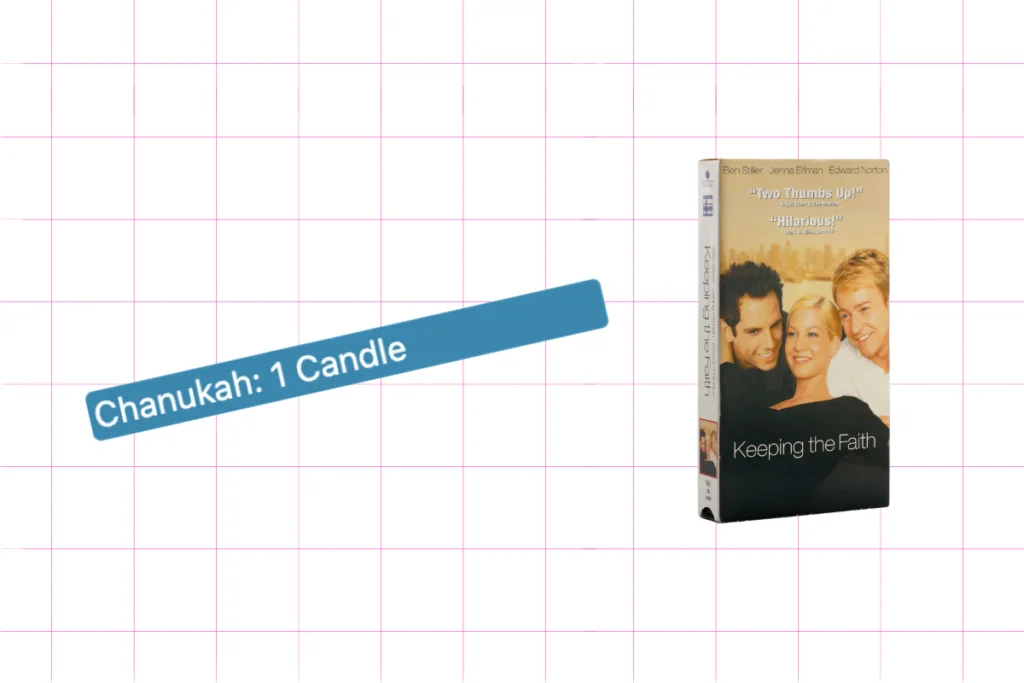
Nathan's last pick is Keeping the Faith, a film she loved as a kid. Three childhood friends reunite as adults: a rabbi, a priest, and the woman they both fall for. The rabbi is played by Ben Stiller and the priest by Edward Norton. Films about interfaith friendship often lean on easy reconciliation, and the better ones use romance and ambition to test how much those bonds can carry. It still hits for her. That's worth taking seriously. A childhood favorite that still lands tells you something about which parts of a culture actually stuck with her.
Why the specifics travel
What stands out across her list is how much of the joy comes from specific, everyday Jewish habits, from holiday planning to overstuffed Shabbat dinners and grandmothers who won't stop stitching. That specificity is probably why the show travels. Viewers who've never sat at that table still recognize the family. I'd argue this is more significant than it looks. Many shows about cultural identity try to explain the culture to outsiders, and the explanations flatten everything they touch. Kid Sister mostly skips that step and trusts the audience to keep up.
That approach carries a risk, and it's worth naming. A show that depends on details can alienate viewers who want a broader hook, and specificity doesn't guarantee an audience. Still, the New Zealand-only window suggests the show had an audience that was real but hard to reach, which is a distribution problem more than a creative one. If you're making or buying comedy for a niche community, that's the lesson to take away: the details that feel too small to matter are often the ones people remember. Seasons one and two are a good place to start.

Discussion
Sign in to join the discussion.