Warnings alone rarely end screen time well. Agreeing on a stopping point and a clear next step gives kids a way to switch gears without the standoff.

"Five more minutes" tends to arrive right as dinner hits the table. The kid says "okay" without looking up, and ten minutes later the pasta is cold and the kitchen has turned into a negotiation over one more level.
Limits on screens are reasonable, and so is a kid being annoyed about stopping something they enjoy. Here's the thing: a warning only announces that time is passing. It doesn't tell a child how to finish, where the device goes, or what happens next. When the ending is vague, resistance fills the gap. A transition with clear steps, agreed on ahead of time, holds up far better than a countdown.

Agree on the stopping point before the screen turns on
Settle the end time before play begins, and check that it fits the clock. If dinner is at 6:00, ask whether the game your child wants can realistically finish by then. Many multiplayer rounds can't be paused and run well past five minutes, so a promise to "finish the round" can backfire when you need them to stop sooner. Pick a stopping point that matches the time you actually have, and agree on when new rounds stop starting. Then name the backup for an overrun, such as leaving the match at the agreed time.
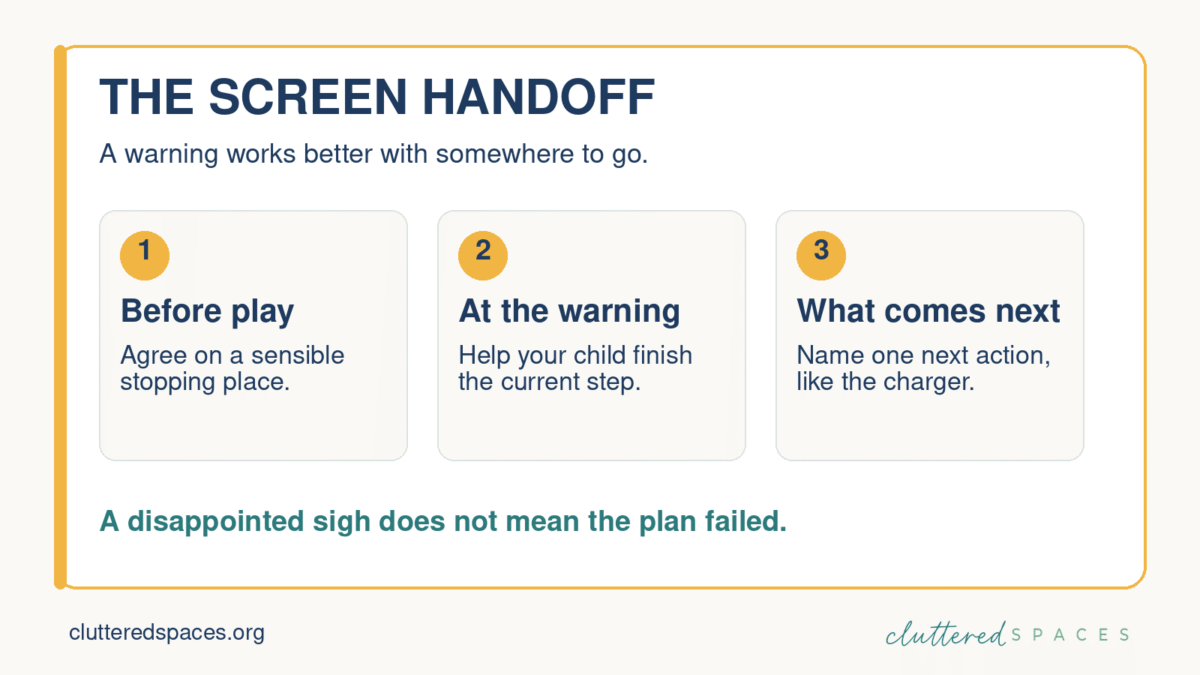
Then ask what kind of warning works for your child. Some kids respond to a visible timer. Others need you to walk over and get their attention, because a voice from the next room doesn't register. Younger children often need a parent beside them while they put the device away. Older kids may want to handle it themselves, and that's worth honoring when they can. No timer or house rule replaces learning what helps your particular kid switch gears.
Give the transition a shape
"Screens off" names what ends. It doesn't tell a kid what to do next. Try something more specific: "Pause the game, put the tablet on the charger, and come wash your hands." If that's too many steps at once, start with the charger alone. Make sure it's easy to reach. A charger buried under a pile of mail won't help anyone.
When time's up, get close enough to be heard and point back to the agreement: "It's 6:00. Save where you can, put the tablet on the charger, and come to dinner." If pushback comes, acknowledge it: "I know you wanted more time. We agreed to stop now so we can eat together." Your kid doesn't need to feel cheerful about it. The goal is to name the disappointment, offer the help you agreed on, and keep the boundary intact.
Picture a school night with twenty minutes of play while you finish cooking. Together you pick something that can be paused or wrapped up in that window. At the warning, you point out the agreed stopping point. When time is up, the tablet heads to its usual spot and dinner comes next. If your child needs a minute to settle before joining you, build that pause into the plan rather than treating it as defiance.

Plans slip during busy weeks, and that's normal. Go back to the same three steps rather than rebuilding the whole system from scratch.
Make what comes next worth stopping for
A game might be how your child winds down after a loud school day. It might be where their friends are, or the only predictable quiet in a busy house. Ask what they like about it before deciding what replaces it. "Find something else to do" hands a frustrated kid a fresh set of decisions at the worst possible moment.
Offer a few real options instead: music and a snack, drawing, time outside, or a seat near you while dinner comes together. Let your child choose among them. If every alternative sounds like a chore, the screen wins the popularity contest every time.
The American Academy of Pediatrics encourages families to think about media use alongside sleep, physical activity, and time together. If screen endings regularly end in intense distress, look at the bigger picture: timing, content, fatigue, and the rest of the day. A pediatrician can help sort that out if the pattern persists. The AAP's guidance on building a family media plan is a useful starting point.
Repair the ending when it goes sideways
Some endings go badly. Return to it once everyone has calmed down. "We both got upset. What should we change for tomorrow?" Adults owe repair too: "I called you earlier than I said I would. Next time I'll give you the warning we agreed on." Keep the limit, but change whatever made stopping harder than it needed to be.
Then review it together. Was the warning useful? Was the stopping point realistic? What support was missing? Each answer shows you what to adjust before the next game starts. The next five-minute warning will land better when the last one taught you something.



Discussion
Sign in to join the discussion.