A rabbi maps three Talmudic reasoning patterns onto Nathan Fielder's work, from Theranos claims to cockpit communication.

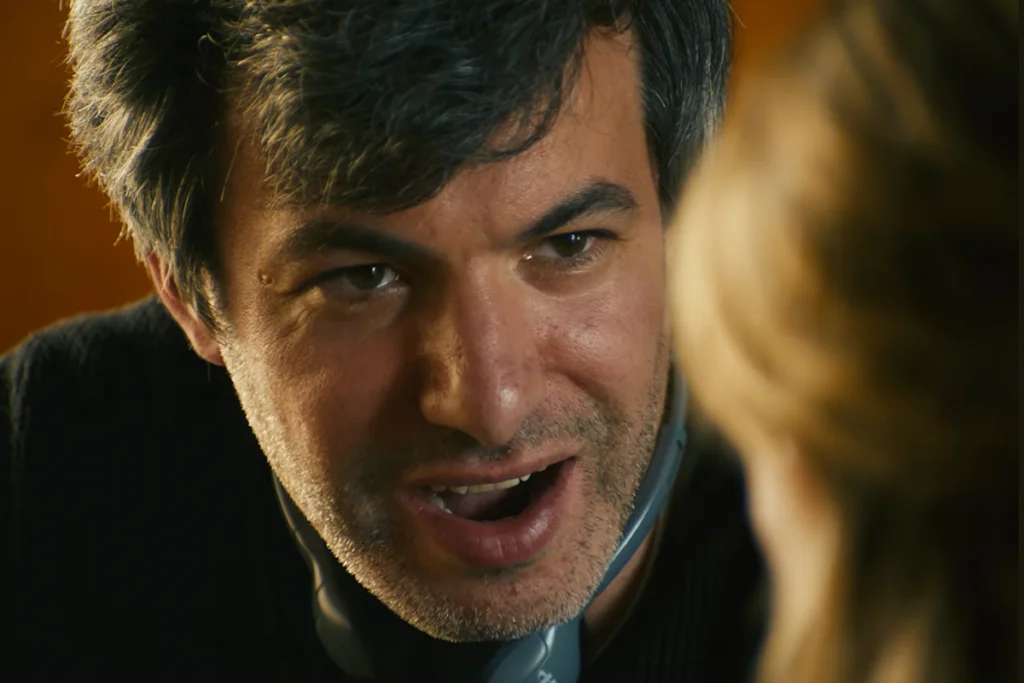
I came to Nathan Fielder the way most people did: through the trailer for "You Can See Everything," his documentary about Elizabeth Holmes, which spread fast enough that I had to see what the fuss was about. I started with season two of "The Rehearsal." Within a few episodes, I noticed something a rabbi tends to notice.
Fielder keeps circling obvious questions, pushing arguments until they break, and staying with the discomfort of not knowing. That's the method of the Talmud. The rabbis who shaped Jewish law didn't settle for the first answer. They tested every premise, followed it to its extreme, and argued about what it really meant. Watching Fielder work, I kept thinking of the beit midrash. So here's my case, through three patterns where his work lines up with Talmudic reasoning.
Two claims that contradict each other can both be true, depending on the circumstances.
Ukimta is a technique for identifying the specific conditions under which two seemingly contradictory statements can both hold. In "You Can See Everything," Fielder presses Holmes on her claim that the Theranos machine could run a wide range of blood tests. He points out that it never successfully ran them. Holmes insists it can.
To work out how she could sincerely believe both, Fielder shows her the Abbott and Costello "Who's on First?" routine. Holmes laughs, but says she can't explain why it's funny, only that it is. In the sketch, both men say "who," but one hears a name and the other hears a question. Could Holmes be doing something similar? When she says the machine can do the tests, maybe she's describing what she believes it's capable of. Fielder is asking what it has actually done.
That's an ukimta move. By examining the assumptions behind each claim, Fielder shows how two people can use identical words and mean different things. It doesn't excuse the promises. The machine still couldn't do what she said it could. But it gives us a view into how someone might have talked herself into believing otherwise.
If a principle holds at low stakes, it holds even more when the stakes rise.
Kal v'chomer runs on a simple logic: if something is true in a minor case, it's all the more true when the stakes go up. Season two of "The Rehearsal" feels built on that premise. Fielder looks into aviation crashes and finds a noticeable breakdown in communication between pilots and co-pilots. If that communication matters on an ordinary flight, how much more does it matter when something goes badly wrong?
He tests this through scenarios that grow more absurd, and funnier, as they go. One involves a singing competition in which co-pilots serve as judges, and the question is whether they can deliver an uncomfortable rejection with ease. Fielder takes the discomfort out of the cockpit and gives people a place to practice saying what no one wants to hear, in hopes the skill carries over when it counts. The absurdity ends up exposing something serious. Failing to speak up can be the difference between life and death.
The obvious question often leads to the deeper answer.
Hava amina/maskana moves from an initial assumption, the hava amina, to a settled conclusion, the maskana, through questioning, debate and close examination. "You Can See Everything" follows that arc. Audience members walk in knowing Elizabeth Holmes for her crimes, and perhaps not much more. Fielder's film argues that, whatever we assume, it's still worth asking the obvious questions and trying to understand how Holmes saw reality. Some of the biggest laughs came when Fielder asked questions that sounded simple. But were people laughing because the questions were funny, or because he was naming the elephant in the room?
I didn't expect Nathan Fielder to make me feel compassion for Elizabeth Holmes, but he did. My conclusion about her guilt didn't change. Still, I found myself relating to her and feeling sad for her. The film gave me a fuller sense of her humanity, and that doesn't cancel out her crimes.
There's something admittedly absurd about putting the sacred, serious study of Talmud next to a comedian who has built a career on being ridiculous. Maybe that's the point. The Talmud is full of absurd hypotheticals, unlikely scenarios and questions pushed to their limits. If we can find the Talmud in Fielder's humor, we might also rediscover the humor that was in the Talmud all along.



Discussion
Sign in to join the discussion.