Short on time? These no-prep games for kids fit into five, fifteen, or thirty minutes and build the connection that matters most.
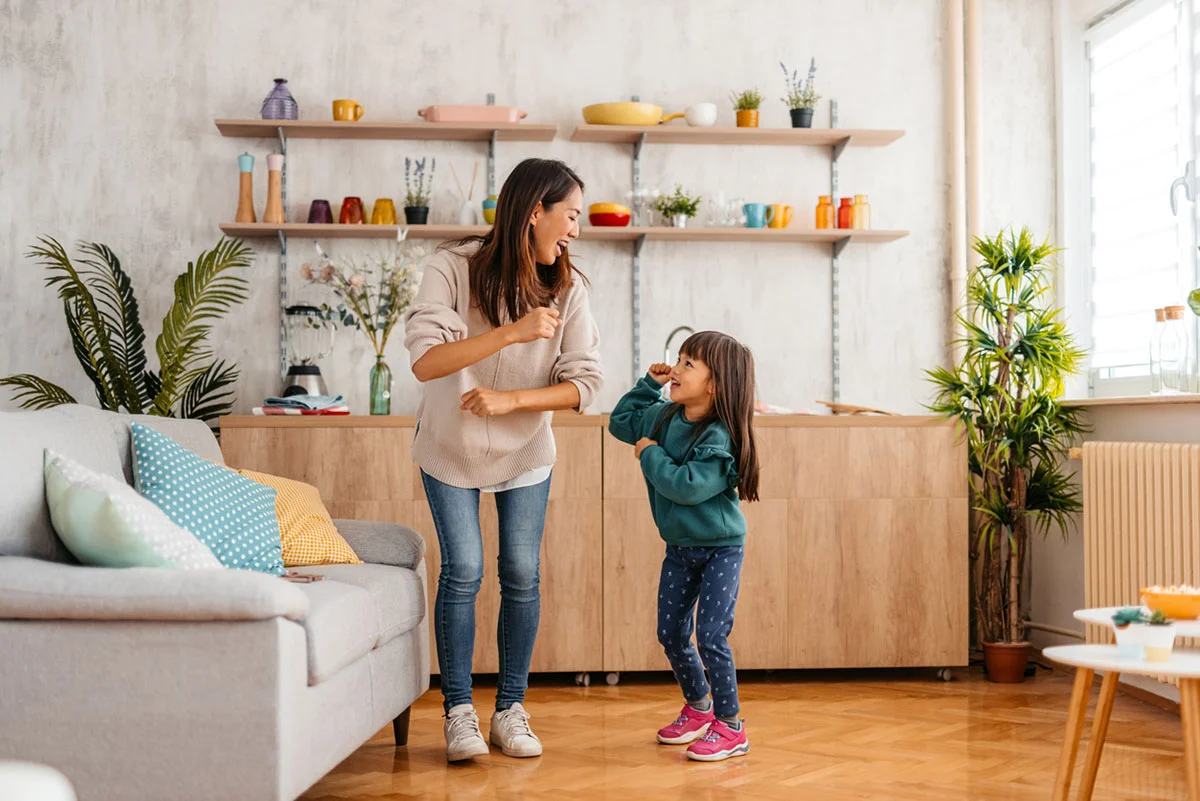
Most parents don't need a reminder that the day runs short. Between work, chores, and the general noise of everyday life, finding an unbroken stretch for your kid can feel like the hardest item on the list. Kids carry their own pressures, too, from school to friendships to plain old restlessness. That's why even brief, undistracted time together carries more weight than it might seem.
Frequency beats duration
Randy McCoy, VP of Product & Curriculum for The Little Gym, puts it plainly. "It's not necessarily the 'duration of play' but the 'frequency of play' that matters most," he says. "If a parent can give their child their undivided attention and play with them just five minutes a day, every day, they're on the right track."
That reframes the goal. You don't need a free Saturday afternoon to matter. You need a routine, even a small one, where your kid knows that a few minutes with you is reliable. The ideas below are sorted by how much time you have, and almost all of them require little or no prep.
Five-minute games for in-between moments
These work before school, after dinner, or while waiting in line somewhere. Nothing needs to be gathered or set up.
Ask "Would You Rather?" with a kid-friendly twist. Take turns posing silly dilemmas. Would you rather never eat ice cream again or get a trampoline? Would you rather ride a dinosaur for 20 miles or an elephant for an hour? The goofier, the better. It also doubles as a road trip game when the car gets quiet.
Run a dictionary dash. Open a dictionary to a random page, read a word aloud, and let the kids guess its meaning. Once they can read, flip the roles so they can stump you.
Trade jokes and riddles. You don't need a writers' room to get a laugh out of a six-year-old. Riddles and brain busters do the job, and a stock of kid jokes keeps you from running dry.
Play a picnic alphabet game. The first player says, "I'm going on a picnic," and adds a packable food that starts with A, such as apple, apricot, or avocado. Each player repeats the list and adds one more. Go in ABC order, or pick a single letter per round to make it harder.
Play 20 questions. Think of something in the room, or something visible from where you're standing, and let the kids work their way toward the answer. Keeping the object simple helps younger players stay in the game.
Try Janken, Japanese rock-paper-scissors. The familiar rules still apply, but the chant is the fun part. Open with "saisho wa guu," then pump your fist with "janken pon" before throwing your hand on "pon." It's quick, needs nothing, and works at home or on the go. You can read more about the game's history here.
Turn yourself into a spot-the-difference puzzle. Stand still for a moment so your kid can study you, then step out of sight and make a small change. Took off a cap? Added a scarf? Untied a shoe? Keep changes obvious for little ones and subtle for older kids. Then flip roles and let them try to stump you.
Start a sequencing game. Pick a letter and name a person, a place, and an object that all begin with it. Link them together in a chain, like "Alice from Australia loves alligators!" The next player repeats the chain and adds their own. See how long you can keep it going before someone gets stuck.
Fifteen minutes to play a little more
Fifteen minutes gives you room for something with a bit more structure, and it's where parent and child can slip into a different dynamic. McCoy describes it well: "It provides an opportunity for you to interact with them on a different level. For a special moment, you step out of the 'parent' role and step into a playmate role." These options will give the kids a lift and give you a short break from the to-do list.
Play a sticky-note guessing game. All you need is a stack of Post-it notes and a pen. Choose one person to be "it." Write the name of a character your kid will recognize from a book, movie, or show, which can be a fictional character, a famous person, or someone you both know. Stick the note on the player's forehead without letting them peek. The rest of the group takes turns giving clues until "it" guesses who they are. It works well at a party, too.
Set out a basket of books. Put a basket of picture books in a common area, and kids will often drift over to flip through pages when they have a spare moment. Adding a bookmark that tracks reading time can turn that drift into a habit.
Keep a sensory bin ready. Stock a bin with dry beans, cotton balls, and small trinkets to bury and dig for, plus cups for pouring and spilling. Keep the contents on a shelf between uses. When you have a short window, pull it out and let the kids dig and drizzle until it's time to move on.
Race cotton balls with straws. This one suits the kitchen table while lunch is being prepared. Siblings can compete for the lead on a straight run down the middle of the table, or you can build a simple obstacle course with cups for the kids to weave around. Ready, set, blow.
Give a penny for their thoughts in a journal. A few minutes of daily writing can grow a young writer's confidence. Offer prompts that spark imagination, such as "The first time I tried…," "When I get to be principal, I'll…," or "The craziest thing that happened today…" Let them run with whatever comes out.
Play animal charades. Pick an animal and act it out without speaking. No props are needed. Each correct guess earns a turn for the next player, and the animals get wilder as the game goes on.
Half an hour or more for projects
Longer blocks of time suit activities with a bit more planning. Plan ahead, and the half hour becomes a stretch where you can sit back and let the kids take over. It's worth the setup.
Challenge them with LEGO. LEGO is the reliable fallback for a reason. To give it a half-hour arc, add a goal: build a car that can also work underwater, or construct a tower at least 24 inches tall. Then let your young master builder take the lead.
Make spinning tops from Perler beads. Ana at Babble Dabble Do shows how melted Perler beads can become spinning tops. The project doubles as a science lesson and a magic trick when the colors blend in motion. It's a good make-and-play option that fits a busy afternoon.
Try a movement card game. Print the Alerting Activity Game from Training Happy Hearts, and laminate the cards if you want them to last. Prompts like "jump up and down ten times" or "pretend to be a volcano" give high-energy kids a structured outlet, and they can work through the deck on their own or with you.
Paint what you find outside. If the yard is bare of snow, gather leaves, evergreen boughs, and sticks. Bring them to the craft table and decorate them with paint. Acrylics hold up well on natural materials.
Sixty-minute sessions
For activities that fill a full hour, a two-step approach works well: make something, then play with it. A little prep the day before, like placing craft supplies in a single bin, makes it easy to pull everything out and surprise the kids.
Play a round of War. The card game is simple to learn and surprisingly hard to win. Each round, the higher card takes both, and ties trigger a quick battle. A game of War can run longer than an hour, but it rarely runs shorter. You can find the full rules here.
Build a mini catapult. Little Bins for Little Hands offers a tutorial that uses craft sticks and other common office supplies. Once it's built, set up targets and let the marshmallows fly. Kids get a physics lesson without realizing it.
Put on a puppet show. Puppets never really go out of style. Make them from an old sock, a brown paper lunch bag, or favorite characters glued to craft sticks. Stock the craft bin with googly eyes, buttons, yarn, and other odds and ends so the kids can give their characters personality. Drape an old sheet or a baby blanket over a table for a stage, and let the performances begin.
Where to start
Don't try to fit all 21 ideas into one week. Pick two or three that match your kid's energy level and keep them in rotation. The five-minute games are the easiest to repeat daily, which fits McCoy's point about frequency. Save the longer projects for weekends or the days when the calendar opens up. Over time, those small, regular moments add up to the kind of connection that a single big outing rarely builds.



Discussion
Sign in to join the discussion.