Six painter’s tape lines spaced a foot apart turn into jumping, balancing, stretching and measuring games that get kids moving indoors.
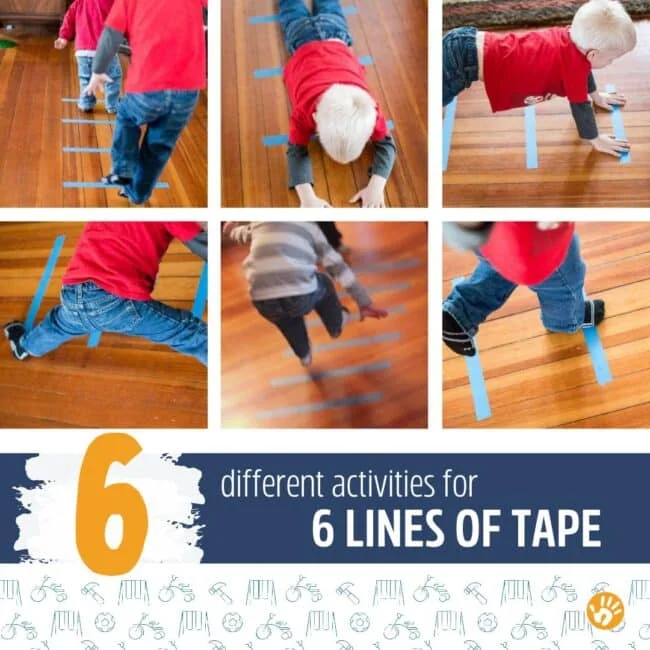
Six strips of painter’s tape can turn a stretch of floor into a movement course for young children. Spaced about a foot apart, the lines invite jumping, hopping, balancing and body awareness with almost no setup. The appeal is practical: children get a clear prompt for moving, while adults can change the challenge without buying equipment or planning a complicated game.
Build a simple movement course
Lay down six parallel lines, roughly a foot apart, in an area with enough room to move safely. The spacing gives children visible targets, but it needn’t dictate how far they jump or how quickly they move. Start with one instruction at a time, then let children decide whether they want to repeat it, change direction or try a different movement.
Children can take each challenge at their own pace, and an adult joining in often makes the activity more fun. That participation also shows that there’s no single performance to beat: an adult can take a small jump, wobble during a balance attempt or make up a new way to cross the lines. The point is to make movement inviting, not to turn the tape into a test.
The games can be adapted for different abilities. A child who can’t yet hop between lines can still take part by stepping across, reaching toward a line or trying a movement while holding an adult’s hand. Let the child choose what feels manageable, and give them time to try again if they want to. Small adjustments make the course usable for more children without changing its basic setup.
Six ways to use the lines
Each line can serve as a marker, a destination or a prompt to change direction. You don’t need to run all six activities in order; choose one that suits the child’s interest and energy, then change the rules when they’re ready. A simple course leaves room for children to invent their own variations, too.
1. Jump forward
Start behind the first line and see how far you can jump. Children can aim for the next line, try to clear a line, or choose a closer target if a longer jump feels like too much. You can also ask them to jump from one line to the next or skip over a line. Keep the challenge playful: the aim is to notice the movement and have another go, not to insist on reaching the farthest mark.
2. Jump backward
Repeat the jumping challenge while moving backward, keeping the distance comfortable for each child. Moving in a less familiar direction changes the task, even when the lines and jumping motion stay the same. An adult can demonstrate a small backward jump first, then let the child decide whether to try it. If the movement feels uncertain, shortening the distance or returning to forward jumps keeps the game within reach.
3. Hop on one foot
Try hopping in place or moving between lines on one foot. Children can switch feet, pause between hops or start by standing on one foot without moving. Those are useful ways to take part while they work out what feels comfortable. Children who want extra support can hold an adult’s hand; the adult can stay close and let the child set the pace instead of pulling them through the movement.
4. Stretch between lines
Place one foot on the first line and keep it there. Reach the other foot as far forward as you can, then switch sides. The lines give children a visible reference for how far they’ve reached, but there’s no need to stretch to the next mark. A short reach counts, and children can move their feet closer together whenever they want to make the task easier.
5. Walk your hands forward
Stand on the first line, bend down and touch the next line with both hands. Walk your hands forward to see how far you can reach. Children can stop at any line, then walk their hands back toward where they started. This turns the course into a different kind of movement challenge: the hands travel while the feet remain behind, so children have to control their reach rather than jump from one target to another.
6. Measure your height
Lie beside the tape lines to see how much space your body takes up. The marks make an abstract idea more visible: a child can compare the length of their body with the gaps on the floor without needing to treat the result as a formal measurement. Older children can record and compare measurements; younger ones can simply enjoy the game. Keep the focus on exploring the space, since children’s bodies and measuring approaches vary.
Make it work for your space
Painter’s tape can damage hardwood floors, so the surface matters as much as the game. Delicate surface painter’s tape may be a better choice, but test it first in a hidden spot and check that it comes away cleanly. Carpet and tile are other options, or take the activity outdoors and draw lines with sidewalk chalk. The setup should suit the available surface; there’s no need to force tape onto a floor that may be marked by it.
Leave enough room around the course for children to move without running into furniture or other obstacles. The activity can be kept short and changed as interest shifts. A child might spend a few minutes jumping, then turn the lines into targets for a hand-reach challenge. And this is the part most people overlook: the same simple layout can support very different movements, depending on what a child wants to try.
Why a low setup can matter
This is more significant than it looks. For families or caregivers who want an easy way to prompt movement, six lines offer clear choices without a long explanation or specialized gear. That simplicity makes it easier to join in, adjust the challenge and stop when the child has had enough. It also gives children a chance to make decisions about how they move, rather than follow a fixed sequence from start to finish.
If you’re working in this space, the useful lesson is that an activity doesn’t need elaborate equipment to invite experimentation. The adult’s role is mostly to set up a safe place, demonstrate when helpful and adapt the game to the child. That said, tape marks can suggest targets without guaranteeing that every child will enjoy every challenge. Some may prefer to step, reach or watch before trying. And yet, a small course can still offer several ways to participate.
Joining the games yourself can encourage children to give them a try. Whether they jump across several lines or stay close to the starting point, the six strips offer plenty of ways to move and play. No record required.

Discussion
Sign in to join the discussion.