The Maccabeats’ new video moves from centuries-old melodies to “Candlelight,” showing how Hanukkah music keeps growing across generations.
A long view of Hanukkah music
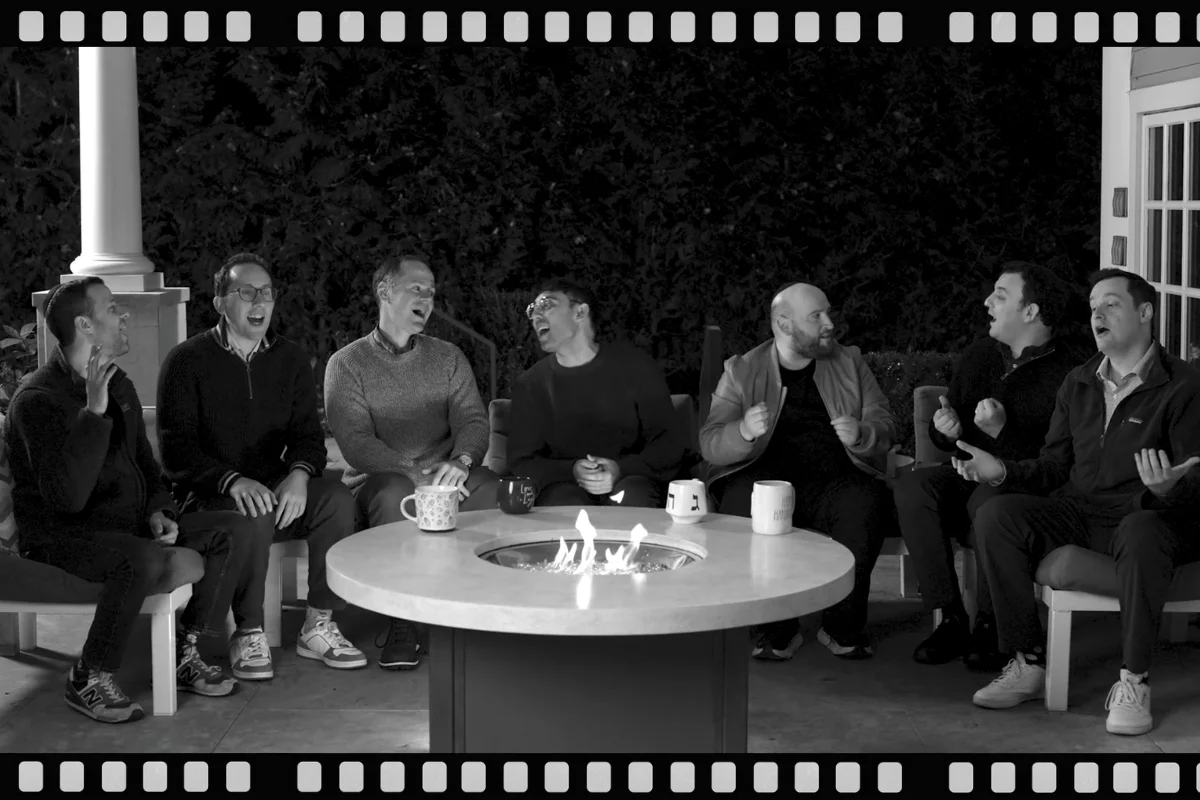
The Maccabeats’ new Hanukkah medley makes a case for a musical tradition that stretches across centuries—and includes songs the group has written itself. “Evolution of Hanukkah Music” packs 30 selections into one video, moving from melodies rooted in the 1400s to modern holiday favorites. That span gives the performance a useful premise: Hanukkah music isn’t a fixed collection of old standards, but a body of work that keeps changing as communities make, adapt and remember songs.
A musical history by the fire
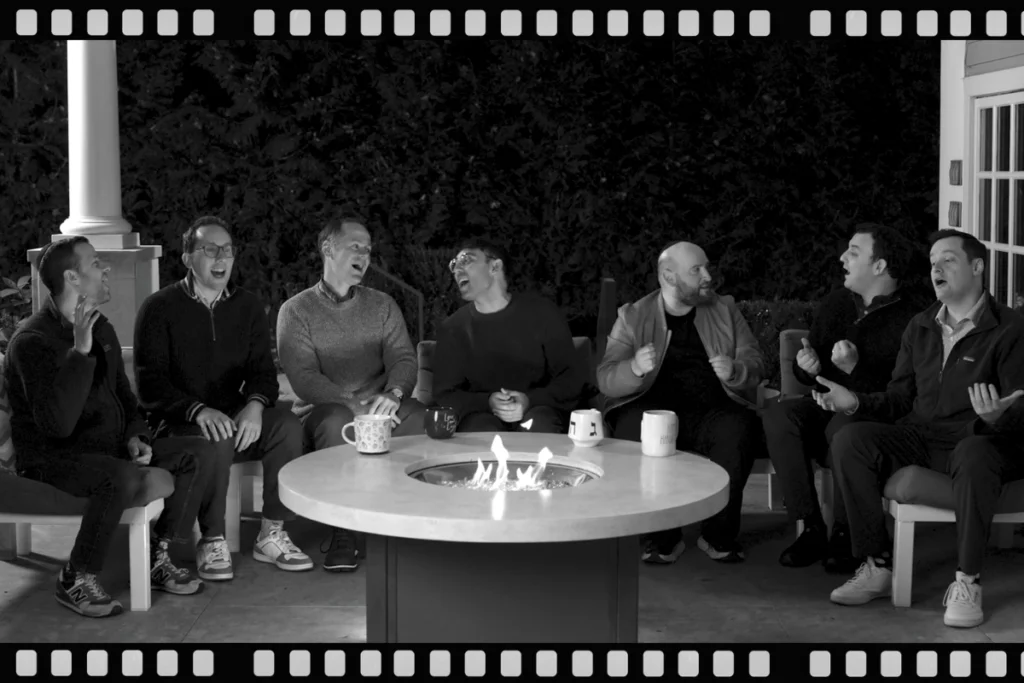
Instead of reshaping a current pop hit into a Hanukkah parody, as they did with last year’s “HanuKpop Demon Hunters”, the group takes a long view. The video gathers its singers around a fire with festive mugs, giving the performance the feel of a camp sing-along set inside a winter holiday special. That setting helps make a large musical timeline feel informal: the group is presenting a history lesson, but one designed to be sung along with rather than studied from a distance.
Julian Horowitz, the Maccabeats’ music director, said the concept draws on Pentatonix’s 2013 “Evolution of Music.” The visual journey includes a shift from black-and-white to color in the 1970s, an echo of that earlier video’s “Wizard of Oz” moment. It’s a compact visual cue, but it also makes the passage of time legible to viewers who might not recognize every song. The arrangement has to carry much of the historical work; the images give the audience another way to follow the changes.
The arrangement crosses eras and musical cultures, bringing together traditional melodies, childhood favorites and newer holiday songs. That range pushes back against the idea that Hanukkah has only a small handful of familiar tunes. “There’s also this notion that there’s no good Hanukkah music, which simply isn’t true! There are hundreds of years of great Hanukkah music,” Horowitz said. The medley’s format makes that point by placing very different kinds of songs in the same continuous performance, where a change in style becomes part of the argument.
Familiar songs, unexpected dates
Part of the medley’s appeal is hearing how recently some seemingly timeless standards arrived. Flory Jagoda’s Ladino song “Ocho Kandelikas” and Peter, Paul and Mary’s “Light One Candle” both date to the 1980s. Debbie Friedman’s “The Latke Song,” also known as “I Am a Latke,” followed in 1990. Those dates complicate the way listeners often sort holiday music into “traditional” and “modern”: a song can feel established through repetition, even when it’s only a few decades old.
The lineup also includes the Yiddish song “Oy Chanike”, alongside Hebrew melodies that may be less familiar to many listeners. A Maccabeat delivers an impression of Adam Sandler while performing his 1994 “The Chanukah Song,” adding a comic interlude to a sequence that spans languages and styles. With 30 tracks to choose from, even traditional pieces posed tough decisions: Horowitz said selecting among different melodies for “Maoz Tzur” was one of the hardest parts. That choice points to a challenge the format can’t resolve completely: a medley can suggest the breadth of a tradition, but every selection also leaves other versions and songs out.
For listeners, those omissions may be part of the invitation. If you’re working in this space—performing, teaching, or making holiday playlists—the video offers a reminder that a familiar title can carry multiple musical histories. And this is the part most people overlook: the act of choosing a melody is itself a kind of interpretation.
The group joins its own canon
The emotional center arrives when the medley reaches the Maccabeats’ Hanukkah parodies, including 2010’s “Candlelight.” The song has since drawn about 18 million YouTube views, but its early success surprised the group. Horowitz recalled checking the count after Shabbat the morning after its Friday release and finding more than 2,000 views. A week later, it had reached a million. The story gives the song a place in the group’s history beyond its later popularity: it was a release whose audience grew faster than the musicians had expected.
That arc gives the video a second layer: the Maccabeats are revisiting the songs that shaped their own place in Hanukkah listening. “Candlelight” now sits alongside much older melodies, while younger listeners are making new memories with it. The sequence treats the group’s work as part of an ongoing tradition, rather than as a novelty separate from the older material. That’s a confident choice, and a more interesting one than simply listing the group’s past hits.
What the medley suggests about the tradition
The medley’s clearest takeaway is that the holiday’s soundtrack keeps expanding—and each generation gets to add a song of its own. Its historical sweep doesn’t claim that all the music serves the same purpose or comes from the same background. Instead, it shows how songs can share a holiday and still reflect different languages, eras and tastes. The numbers here are underwhelming only if you expect a definitive survey: 30 selections can’t stand for every Hanukkah tradition, and the video doesn’t need to.
What this means for you as a listener is fairly simple: a song’s age isn’t always obvious from how familiar it feels, and a holiday repertoire can be both inherited and newly made. The Maccabeats’ own songs become part of that story because listeners have taken them up and attached memories to them. More songs to come.

Discussion
Sign in to join the discussion.